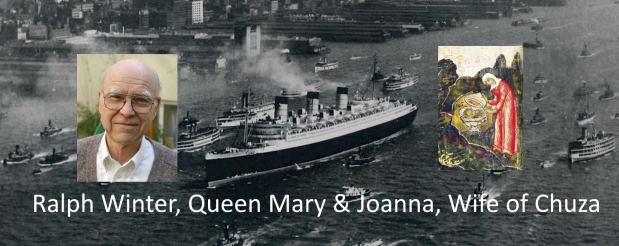
After this, Jesus travelled about from one town and village to another, proclaiming the good news of the kingdom of God. The Twelve were with him, and also some women who had been cured of evil spirits and diseases: Mary (called Magdalene) from whom seven demons had come out; Joanna the wife of Chuza, the manager of Herod’s household; Susanna; and many others. These women were helping to support them out of their own means. – Luke 8:1-3 [NIV]
This is a reflection that I shared with my colleagues at IFES/USA:
When it comes to women and money for ministry in the Gospels, we’re often referenced to the sacrifice of the widow’s mite. But these verses in Luke 8 present a much more compelling picture.
Last summer, at the International Fellowship of Evangelical Students World Assembly in Jakarta, I had the opportunity to talk with a number of people about what I do for IFES. People said, “Wow, a grant writer. That sounds like a very important job.” And my first response was, “Well, I’m just a lowly, part-time employee.”
But then, for some reason, my mind flashed back to an Urbana seminar I attended with Ralph Winter way back in the nineties. Ralph Winter was a distinguished missiologist and major missions strategist. He helped pioneer Theological Education by Extension, was the instigator of the Unreached Peoples Movement, and founded the US Center for World Missions (now Frontier Ventures) in Pasadena, California.
His Hidden Peoples presentation at the 1974 Congress on World Evangelization in Lausanne, Switzerland, revolutionized missions by showing that traditional outreaches focused on political boundaries weren’t reaching all of the people; the focus needed to be on people groups and not just countries.
Ralph Winter never spoke at the Urbana student missions conference as a plenary speaker but he did lead seminars. He also made Urbana accessible to more people by creating what was essentially Urbana by extension, known as the Perspectives on World Missions course, which still continues as part of Frontier Ventures.
Knowing his stature in the world of missions I looked for his presence on the list of seminars when I covered Urbana as a radio news reporter. And there was that one time when he said something that really surprised me. My recollection is that he posed a question, something to the effect of, “Who are the most important people in missions?”
His response was not missionaries, as we might think, but rather, the people who financially support missions; because without financial resources, missionaries are not able to do what God has called them to do.
This happened around a third of a century ago and I realize that my memory may be a little fuzzy. I contacted Greg Parsons, who I had met at Urbana 18. He worked with Ralph Winter at the US Center for World Missions for many years, did his PhD on Ralph Winter, and is still with Frontier Ventures.
This scenario didn’t sound familiar to him. He suggested that if Ralph Winter would be asked such a question, he would usually say the most important people in missions are mobilizers for missions. And looking at all that he did during his career, that makes perfect sense. Urbana is all about missions mobilization and so is the Perspectives on World Missions class.
But, I still think he said what I remember him saying.
Reflecting on the Apostle Paul’s writings about the body of Christ, we know that there is no single most important role in the Christian life, or in missions. In truth, missions supporters through prayer and money, missions mobilizers, and missionaries all play critical roles. All heard the call of Jesus to the fields which are white unto harvest and are answering in their own way, as the Spirit has led them, as members of the body of Christ.
You may have heard this saying about missions: “You are either a missionary or a mission field.” That’s meant to get us started thinking seriously about missions. But I would say thinking strategically about missions is not binary but triangular. The triangle points are missionaries, missions mobilizers, and missions partners who pray and financially support missions. Effective missions needs all three. And missions mobilizers can actually mobilize for either of the other two categories: to call people to the mission field or to call people to be missions partners.
Our role at IFES/USA as missions partners mobilizers is, I think, just as important as missionary mobilizers. It’s a very unique role. The success of missions depends on both types of mobilizers.
Jesus was a mobilizer . He called the disciples to be fishers of men. But how did he mobilize his missions partners, the women? According to Luke 8:2-3, he healed them of evil spirits and diseases.
The ladies described in these verses had been significantly impacted by the ministry of Jesus. They were not called to be fishers of men. But after experiencing the ministry of Jesus in a miraculous way, they could not do nothing. These women don’t get much of a mention in the Gospels but with these two verses they are listed in the credits, as it were, like the credits at the end of a movie. Just a couple of verses here in Luke’s Gospel that we probably haven’t paid a lot of attention to in the past.
Who are these ladies?
Mary Magdalene is mentioned a number of times in the Gospels, we’ve all heard of her. She did get a prominent role in the rock opera Jesus Christ Superstar, singing I Don’t Know How to Love Him. Joanna is mentioned not just here but also in Luke 24, with Mary Magdalene and other women who went early in the morning to the empty tomb, and then informed the apostles that Jesus has risen from the dead. Susanna gets mentioned here and here alone, we know hardly anything about her. And Luke here also references “many others,” additional numbers of women.
I don’t imagine most of us have given a lot of thought to the logistics of Jesus ministry. The Chosen TV series has started to wander into this territory in season 3 as Mary Magdalene and other women help Zebedee with a new olive oil scheme to raise money for the ministry. I don’t think this is exactly what Luke is describing. And I don’t think he’s just describing cooking and mending.
Mary Magdalene, Joanna, and Susanna seem to have some wealth, which may be a little unusual in the context of the first century. Perhaps they were widows of men who had accumulated wealth or daughters of men who died without male heirs.
Their contributions were enough to help with food and accommodations for the disciples as they travel. Interestingly, if Joanna is not a widow or divorcee and is still married to Chuza, then it seems like Herod Antipas might actually be helping to finance the ministry of Jesus through the salary that he pays to Chuza.
It’s hard to say too much more about these women without having more information, except for two things:
Luke seems to suggest he got much of his information written in his Gospel account from the women. “Mary treasured these things and pondered them in her heart.” (Luke 2:19) Luke is the only writer who describes a group of women going to the grave on Easter Sunday, not just Mary Magdalene and one or two others.
Some Bible scholars suggest Joanna is the same person as Junia, the wife or sister of Andronicus, fellow prisoners with Paul mentioned in Romans 16:7. Their two names sound identical when Junia is pronounced in Latin and Joanna in Hebrew.
Interesting speculation that we will have to leave for the time being.
When I emailed Greg Parsons, he said that the only time he could remember Ralph Winter addressing financial support for missions was in his writing on wartime lifestyle. Back around 1996 there was a piece he wrote in the magazine of the US Center for World Missions called “Commitment to a Wartime Lifestyle.”
The US Center for World Missions was in Pasadena. Thirty miles to the south is Long Beach, where the Queen Mary is docked. This former luxury liner was also used as a troop transport during World War II. So, apparently, if you go visit Queen Mary, you’ll see how passengers fared during these two different scenarios. In one case there’s a great array of silverware, plates, bowls and cups for dining. In the other case, you have a metal tray with indentations. Fancy staterooms for 3,000 people in contrast to bunk beds eight tiers high so that the boat could carry 15,000 people.
Ralph Winter observed that, “Obedience to the Great Commission has been more consistently poisoned by affluence than by anything else.” He believed the antidote for affluence was consecration, the “setting apart of things for holy use.”
He was in favor of people who are awakened and committed to the Great Commission going to the mission field. But that wasn’t the only option. “They can also stay home and deliberately and decisively adopt a missionary support level as their standard of living and their basis of lifestyle, regardless of their income.”
Using his own denomination as an example, he wrote: “If a million average Presbyterian households were to live within the average Presbyterian minister’s salary, it would release at least two billion dollars a year.”
I discovered that this Ralph Winter article was referenced a few years later by Randy Alcorn, of Eternal Perspective Ministries, in an article called Choosing a God-Honoring Lifestyle. In this article he analyzed what the Gospels say about the apostles of Jesus and whether they totally divested themselves of all their possessions to follow Jesus. An interesting analysis.
Alcorn notes that Jesus has some commands. He called on his followers to deny themselves and take up their cross and follow him. Jesus also said, “Do not lay up for yourselves treasures on earth” in the Sermon on the Mount.
Each of us as Christians must consider these admonitions on stewardship and others that come from Jesus and Paul in the New Testament. Ralph Winter and Randy Alcorn are not suggesting we should live as paupers and give up all of our money to missions. But if we don’t live intentionally, trying to be good stewards with all that God has blessed us with, it doesn’t seem that we are being obedient to the Gospel.
Alcorn has a book titled Money, Possessions & Eternity, for those who want to explore this more. Using the Queen Mary metaphor, he writes, “God called us not to a cruise-ship mentality but a battleship mentality.”
-30-
 RADIOSCRIBE