The Shephelah is the foothill region of Israel, between the coastal plain and the Judean hills. In ancient times it was the border between the Israelites and the Philistines, so it has a number of sites of archaeological interest.
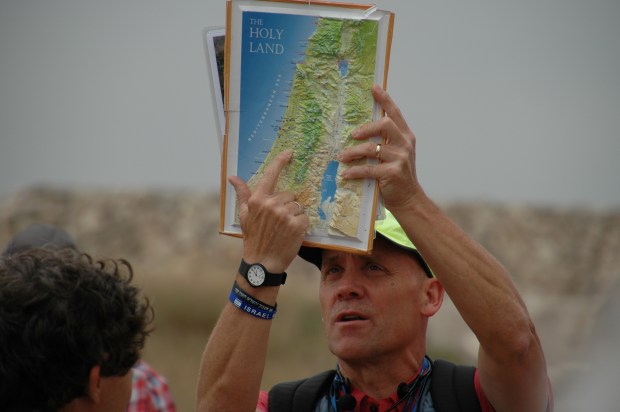
“Here’s the Shephelah,” says our co-leader, Dr. John DeLancey of Biblical Israel Ministries and Tours. We’re actually at the site of Gezer, an important Old Testament city that changed hands several times and was presented as a wedding gift to King Solomon by the Pharaoh of Egypt.
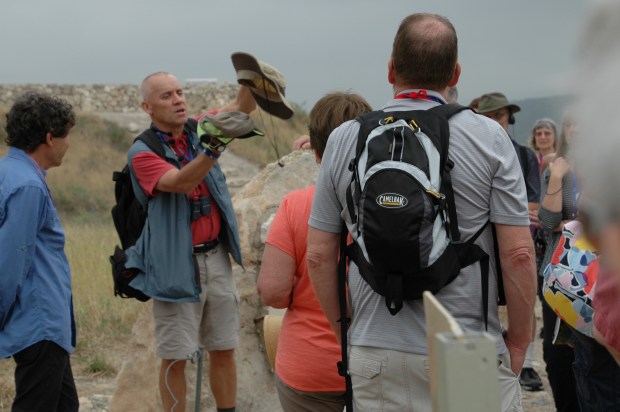
John uses a pile of hats to illustrate how a tell is formed, as one layer of an ancient city is built on top of an earlier layer, time after time over the centuries.

Another illustration of what’s happening archaeologically at Gezer from the back of the T-shirt worn by co-leader, pastor David Simon. The water system in the Bronze Age gate area is currently under excavation and the findings there have implications for other water systems found at other Old Testament city sites. It appears to be about 4,000 years old. On a future tour we hope to have the chance to tour the water system, once the excavation finishes. John worked as a volunteer on this excavation a year or two previous. David’s daughter also works on the excavation.
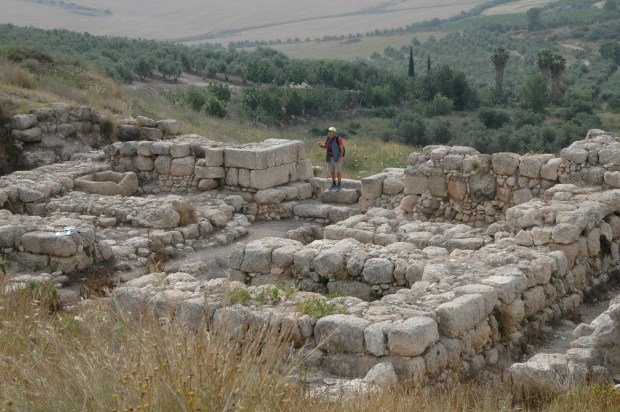
The six-chambered city gate at Gezer, similar to the city gates at Hazor and Megiddo, and attributed to Solomon on the basis of the archaeological record as well as the biblical record (I Kings 9:15 – “Now this is the account of the forced labor which King Solomon levied to build the house of the Lord, his own house, the Millo, the wall of Jerusalem, Hazor, Megiddo, and Gezer.”

Also spotted at Gezer, the remains of a classic Israelite 4-room house, confirmed by my friend (and fellow Wisconsin alumnus) Sam Wolff, one of the co-directors of the dig. “Was destroyed by Tiglath Pileser in 734 bce.”

One of the first landmarks of Gezer, the standing stones, excavated by Macalister just after the turn of the century (the 20th century). Thought to be a cultic installation, but no one knows for sure.

We got to see an actual archaeological dig in progress when we stopped at Beit Shemesh, a salvage dig to prepare for road widening according to appearances. Just after we stopped here it started to rain and the dig ended, at least for awhile.

Another stop, Tel es-Safi, also known as Gath, one of the five main cities of the Philistines. This is the dig John DeLancey worked on later in the summer, excavating a gate area.
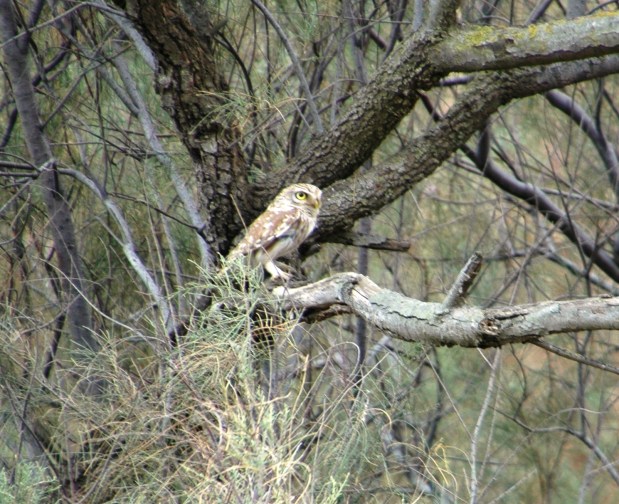
Noticed an owl fly into a tree while we were at Safi. Owls were known as birds of wisdom by the Greeks, the Philistines are believed to be connected to the ancient Greeks.

Was thrilled to finally have a chance to visit Khirbet Qeiyafa on this trip. This 3,000-year old city overlooks the Elah Valley, where David and Goliath had their battle. The archaeological work done there in the last decade has helped scholars better understand the time of King David and Solomon. Unlike most walled cities of the time, it has two gates.

While most of our group stopped for lunch at Beit Guvrin, a few of us explored the adjacent 2nd century Roman Amphitheater. Over a half dozen Roman theaters in Israel, this is one of only three amphitheaters ( an amphitheater is a full circle instead of semicircle). Probably built so that Roman soldiers could watch gladiatoral contests.
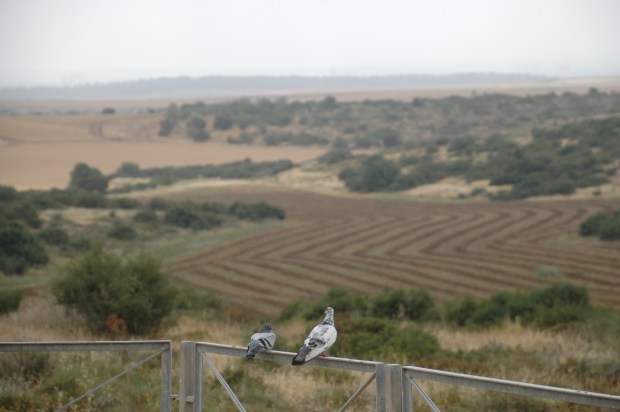
Our next stop, a short visit to the underground city of Maresha, overlooking this fertile valley.

The pigeons which lived in this underground columbarium had a lot to do with the fertility of the land around this city.
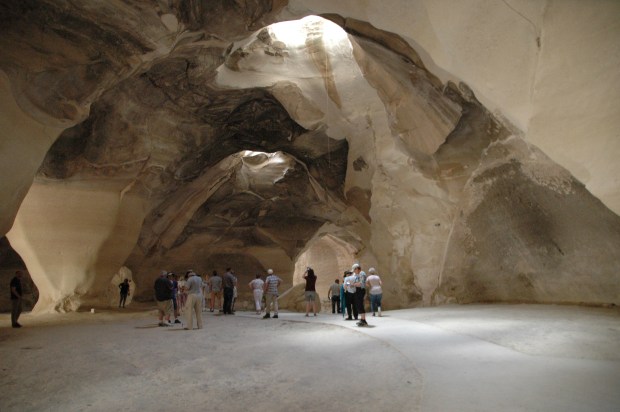
The soft rocks at Beit Guvrin were conducive to cave creation. And to acoustical marvels.
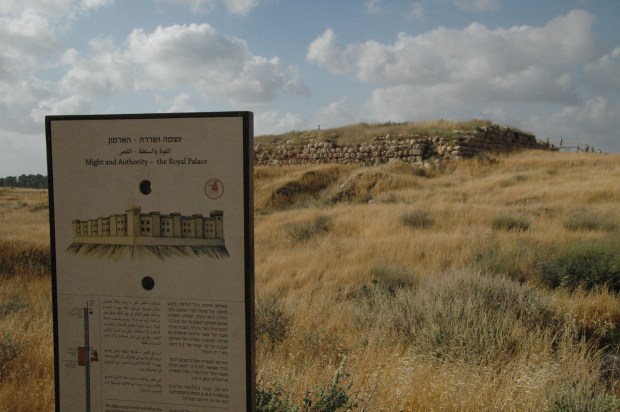
Our final Shephelah stop of the day, Tel Lachish, the second most important city in the ancient kingdom of Judah. It was destroyed by the Assyrian king Sennacherib in 701 BC. The remains of his siege ramp can still be seen.
Continue on to the next day. ==>
 RADIOSCRIBE